


International scientific conference in Geneva, Switzerland, 23–24 April 2026
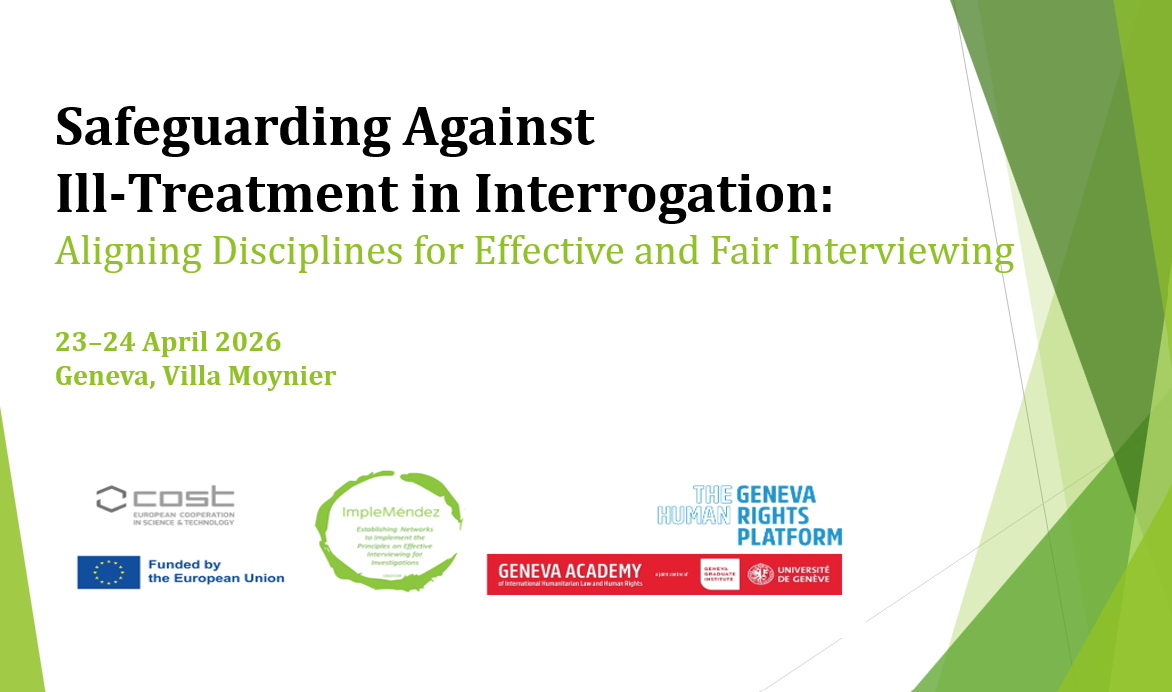
On 23–24 April 2026, an international scientific conference titled Safeguarding Against Ill-Treatment in Interrogation: Aligning Disciplines for Effective and Fair Interviewing was held in Geneva, Switzerland. The event, organised by the Geneva Academy (University of Geneva) in cooperation with the COST Action CA22128 ImpleMéndez project (Working Group 2), brought together experts in law, human rights, and investigative practice, including over 25 members of the ImpleMéndez network. The aim of the meeting was to examine how interdisciplinary approaches can strengthen safeguards against ill-treatment in interrogation and support ethical, evidence-based interviewing techniques.
During the conference, it was emphasised that effective protection of rights must begin at the moment of arrest, function as a system of interconnected safeguards, and be embedded in institutional culture rather than treated as a formal obligation. The programme was structured around four themes. The first day focused on integrating legal safeguards into interviewing practice, as well as on juvenile justice and issues of vulnerability. In this context, participants highlighted the need for a more inclusive approach that takes into account the specific needs of children and neurodivergent individuals—both as interviewees and as interviewers.
The second day began with a presentation by Prof. Juan Méndez, former UN Special Rapporteur on Torture. This was followed by sessions on transparency in interviewing practices, including recording and access to recordings, as well as the management of informal practices. Recording and transparency were identified as key tools for ensuring accountability, although challenges remain regarding their selective use and the protection of privacy. Particular attention was paid to the issue of informal questioning, identified as a high-risk area where individual rights are most often endangered and procedural safeguards tend to weaken.
Discussions underscored the importance of consistency, accountability, and the application of good practices across different jurisdictions. It was noted that effective, inclusive, and interdisciplinary implementation of the Méndez Principles requires continued movement from declarations to practice across diverse professional and cultural contexts, with practice itself reinforcing and operationalising the legal and ethical safeguards that form the foundation of these principles.
Within Theme 4 – Informal Questioning and the Risk to Safeguards, Dr hab. D. Solodov, Professor at UWM, delivered a presentation titled: “Why do informal police interviews occur? Legal and structural drivers in Poland”.